Manufacturers have to ensure that they meet customer needs; this means more than just timely delivery or quality products. Buyers want to know how employees are treated, how workplace safety is monitored, and if the labor conditions are compliant with legal requirements. The preparation to get a SA 8000 certification in Ahmedabad will help companies assess their obligations and implement a systematic approach to social accountability.
However, preparation for certification comprises more than just working out policies or gathering relevant papers before the audit takes place. Companies require a comprehensive understanding of the current practices, identification of the non-compliance issues, involvement of the employees, and establishment of proper processes for everyday functioning.
The guide describes how manufacturers can prepare for implementation of SA 8000, detect the common weaknesses, and improve the social accountability management system.
Manufacturing plants usually have a number of different departments, shifts, supervisors, contractors, and employees working in various positions. Therefore, it can be difficult to ensure continuity in labor conditions.
A company can have procedures related to accident prevention, but there are no viable evidence indicating the training of employees. Another organization may keep attendance registers but faces problems when it comes to proving how the business operates in regard to payment processing, employee grievances, and correction of mistakes.
Such disconnections influence the compliance check process.
Companies that consider obtaining the SA 8000 certification in Ahmedabad should carefully analyze their written procedures and how they correlate with real-life practices.
Another step is to check the current situation at the organization. The management will have to analyze the existing labor requirements, employment records, workplace conditions, and internal procedures of the company with regard to the applied SA 8000 standard.
The analysis should cover the following aspects:
- Recruitment and employment procedures
- Child and forced labor prevention
- Working hours and monthly salaries
- Non-discrimination and equity
- Occupational safety
- Provision of workers’ rights and possibility to make complaints.
If the analysis reveals gaps between the current practices in the organization and the requirements of the applied standard, the management will have a possibility to streamline the existing practices of the company.
Documenting is essential because businesses have to show how their management system works, yet their documents cannot ensure that they have followed the same procedures in practice.
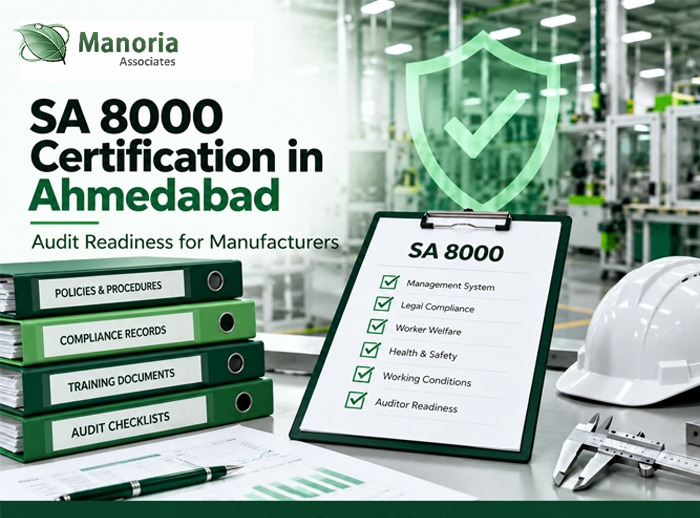
Depending on the business operation and the requirements applicable to it, the preparation may include the following:
The records should be accurate, up-to-date, available for authorized users only, and reflect reality.
If a company wants to get SA 8000 certification in Ahmedabad, the goal should be to create credible proof of compliance instead of focusing only on documents.
Workplace safety includes both physical conditions and methods of handling risks. Manufacturing firms have to analyze machine safeguards, emergency preparedness, cleanliness of premises, safety equipment, and the level of workers’ awareness with respect to hazards.
The organization has to find out whether their employees know how to report hazardous situations and whether the complaints are considered seriously and acted upon.
Workplace safety is not just limited to physical safety. Continued focus on fair treatment, hours worked, protection from discrimination, and access to grievance procedures are also critical parts of social accountability.
Regular checks at the workplace, feedback from employees, and documented follow-up actions can help management identify problems before they become recurrent issues.
A social accountability system cannot work efficiently unless employees are well aware of their rights and responsibilities.
The company needs to communicate the relevant policies in a language understandable to employees. They need to know how to complain, use grievance channels, and participate in consultations or representation.
In addition, supervisors and managers are trained properly since their decisions affect the work of the organization every day.
For example, a supervisor should know how the company operates regarding complaints and how to prevent discriminatory behaviour, keep track of working hours, and report safety problems.
Meaningful participation by employees allows management to detect problems that cannot be identified from the documents alone.
Companies should verify that their procedures are being followed consistently before the formal certification assessment.
An internal evaluation can expose issues such as the lack of documentation, the use of outdated protocols, insufficient training, or inconsistency between established policies and the reality.
All findings must be recorded and analyzed. Senior management should define the root cause, determine accountability, set a deadline for the completion of the corrective task and make sure that the corrective task worked.
It is the same that doing a document correction may not have fixed the initial problem. For example, if the attendance report is made incorrectly, the organization will need to improve its documentation methods and train the people responsible for it.
This strategy allows companies to stay compliant even after the first preparation phase.
Corporate preparation for social accountability assessments requires many stakeholders to work together. The organization will need help with gap assessment, documentation, staff communication, internal evaluation, as well as corrective action plan development.
Professional consultants can help managers analyze requirements, rank their goals, and plan actions based on their company activities.
Manoria Associates offers consultations regarding management systems and can assist in determining the necessary preparation and components for SA 8000 implementation. Before starting the certification process, businesses should make sure to check what version of the standard is going to be applied, what the certification scope is going to be, and what the selected certification body is going to do.
However, consultancy support should not replace the process of obtaining independent certification. The certification has to be conducted according to the required certification procedure and certified by the certified certifying organization.
An effective plan has to set priorities and responsibilities, the amount of resources to be used, and the time frame for the plan’s implementation. In this respect, management should begin with analyzing the existing gaps, reviewing policy documents, improving the procedures, training employees, and conducting internal audits.
The organization should also think about how it is going to monitor the certification performance. Achieving periodic reviews and obtaining workers’ feedback, reviewing records, and taking corrective measures will maintain an efficient system instead of treating certification as a one-time process.
When an organization considers achieving SA 8000 certification in Ahmedabad, its readiness has to be based on the relevant standards applicable at the time and the actual situation. A methodical approach brings efficiency to the process and helps the management enforce accountability.
To sum up, successful SA8 000 certification depends on having a good grasp of the working environment, keeping proper documentation processes, involving workforce, and overcoming compliance gaps in a systematic manner. When a producer has prepared the above-mentioned points before the essential evaluation, they will have a better idea of what they need to do.
Manoria Associates helps organizations with their SA 8000 certification in Ahmedabad process including the assistance with its methodology and relevant policies.